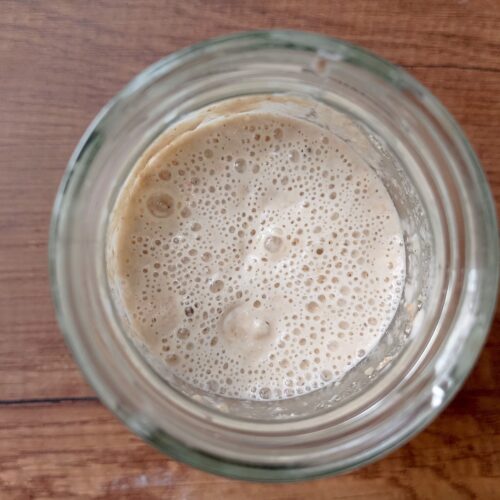
How to Make Sourdough Starter
Learn how to make a healthy sourdough starter from scratch using just flour and water. This easy recipe creates a bubbly, active starter that's perfect for baking homemade sourdough bread.
Equipment
- digital kitchen scale
- 500 ml (1-pint) glass jar
- Spoon or spatula
- Rubber band or marker (optional, to mark the starter's level)
Ingredients
- 625 g whole grain flour whole wheat, spelt, or rye
- 625 g bread flour
- 1.25 kg filtered water
Instructions
- Day 1: In a clean jar, vigorously mix 50 grams of flour and 50 grams of water until no dry flour remains. Scrape down the sides of the jar, cover it loosely with a lid or a cloth secured with a rubber band, and leave it at warm room temperature for 24 hours.
- Day 2: Discard about half of the starter, leaving about 50 grams in the jar. Feed it with 50 grams of flour and 50 grams of water, then stir vigorously until smooth. Cover the jar loosely and leave it at warm room temperature for another 24 hours.
- Day 3: Discard about half of the starter, leaving about 50 grams in the jar. Feed it with 50 grams of flour and 50 grams of water, then stir vigorously until smooth. Scrape down the sides of the jar, cover it loosely, and leave it at warm room temperature for another 24 hours.
- Days 4–6: By now, you should start to see bubbles, a slight rise after feeding, and a pleasantly tangy aroma. Begin feeding your starter twice a day, about 12 hours apart. At each feeding, discard all but 50 grams of starter, then feed it with 50 grams of flour and 50 grams of water. Stir vigorously until smooth, scrape down the sides of the jar, cover loosely, and leave at warm room temperature until the next feeding.
- Days 7–14: Continue feeding your starter twice a day, about 12 hours apart, following the same routine. At each feeding, discard all but 50 grams of starter, then feed it with 50 grams of flour and 50 grams of water. Once your starter reliably doubles in size within 2–4 hours after feeding, it's ready to bake with. My starters usually begin doubling around Day 8 but often need another couple of days before they do so consistently. Remember, watch your starter, not the calendar.
Notes
- Use filtered or dechlorinated water whenever possible, as chlorine can slow fermentation.
- Whole wheat, rye, or spelt flour helps encourage fermentation during the first few days. Once your starter is established, you can feed it with bread flour or all-purpose flour if you prefer.
- Keep your starter in a warm place (around 24–27°C / 75–80°F) for the best results.
- Every starter develops at its own pace. Most are ready to bake with between 8 and 14 days, but rely on your starter's behavior rather than the calendar. It is ready when it reliably doubles in size within 2–4 hours after feeding.
- The flour and water listed in this recipe include the amounts used during regular feedings over the 14-day process, including the portion that is discarded.
- Once your starter is mature, you can store it on the counter and feed it daily, or keep it in the refrigerator and feed it about once a week.